Choosing between forklift hire and purchase is a frequent operational decision for Australian construction firms, warehouses and manufacturers who must balance capacity, cost and uptime. This article explains how flexibility, operational, financial and maintenance-related, should drive that decision and helps supply chain managers and site supervisors evaluate options relevant to Australian conditions. You will learn the primary flexibility benefits of hiring, the scenarios in which ownership gives better control and long-term value, and clear metrics to compare total cost of ownership against rental strategies. The guide also examines how maintenance responsibilities differ between hire and purchase, lays out decision criteria for different business profiles, and shows how a supplier with both hire and sales capabilities can support the right outcome. Throughout, practical examples, comparison tables and actionable checklists will make it straightforward to match your usage patterns and budget to the option that delivers the most flexibility.
What Are the Key Flexibility Benefits of Forklift Hire?
Forklift hire delivers flexibility by allowing businesses to scale material handling capacity rapidly without committing capital to long-term assets. Hiring shifts costs into operational expenditure, shortens lead times for specialist machines, and typically bundles maintenance and breakdown support, which reduces operational risk. Access to a rental fleet also permits rapid model upgrades, for example switching to electric or rough-terrain units for specific tasks, without the depreciation and disposal hassle of ownership. These benefits are especially valuable for seasonal demand, short projects and situations where maintaining a diverse fleet would be inefficient.
Hire scenarios show clear trade-offs across cost, lead time and service inclusion; the table below compares typical short-term and specialist hire use cases to illustrate these flexibility benefits.
The next section gives real-world scenarios that demonstrate operational flexibility in action.
How Does Forklift Hire Support Operational Flexibility for Short-Term and Seasonal Needs?
Hiring forklifts supports operational flexibility by enabling rapid fleet scaling to match short-term projects and seasonal peaks without procurement delays or capital approvals. For example, a construction site facing a three-month piling phase can increase lift capacity immediately through ad-hoc hire, avoiding the procurement lead time and storage costs of purchasing additional units. Seasonal warehouse peaks, such as pre-holiday stock inflows, can be handled with short-term or contract hire arrangements that include scheduled servicing and rapid replacement if a unit fails. Lead times for hire are typically measured in days rather than weeks or months, which keeps project schedules on track and reduces the need to retrain staff on multiple permanently owned models.
These operational advantages also affect workforce and logistics planning because hired units are often delivered fully serviced and matched to the task, reducing on-site setup. That reduction in setup time improves throughput and allows managers to redeploy permanent fleet assets to other tasks without interruption.
What Financial Advantages Does Forklift Rental Offer Compared to Buying?
Renting forklifts shifts spending from capital expenditure (CapEx) to operational expenditure (OpEx), improving short-term cash flow and preserving borrowing capacity for other priorities. Monthly or daily hire fees are predictable and often include maintenance, which simplifies budgeting and reduces unexpected repair bills that erode returns on owned equipment. Rental also eliminates depreciation and the administrative burden of resale or disposal, converting uncertain residual value into a transparent operational cost. For businesses assessing a one-to-three-year horizon, hire can be cheaper when utilisation is low or variable and when the alternative would be under-used capital assets.
To compare objectively, calculate the total cost of keeping a machine available (hire fees + service levies) versus owning (depreciation + finance + maintenance + downtime). This financial comparison clarifies when hire preserves cash and reduces balance-sheet exposure, which is particularly useful for projects where usage intensity is uncertain and for businesses prioritising flexible budgeting.
When Is Forklift Purchase More Advantageous for Long-Term Control and Value?
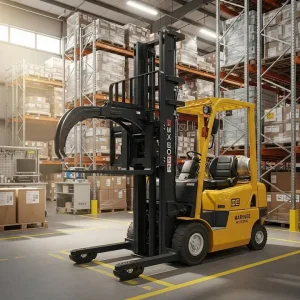
Buying a forklift becomes more attractive when utilisation is high and predictable, because long-term ownership often yields lower cost per hour and provides full control over configuration. Ownership allows customisation, attachments, specialised tyres or bespoke safety fittings, and avoids rental lead times that can constrain operations. Over a multi-year horizon, purchased units can be accounted for as assets, with depreciation and resale value factored into total cost of ownership (TCO) models to determine break-even points versus hire. For organisations with stable volumes, owning enables standardisation across the fleet and simplifies training, parts stocking and maintenance planning.
The following table compares typical purchase scenarios and their longer-term financial and control implications.
| Purchase Scenario | 5-Year TCO Indicator | Customisation | Operational Control |
| High-usage fleet | Lower TCO per hour | Full — attachments and specs | High — always available |
| Long-term site operations | Predictable depreciation | Can be tailored to site | High — no rental lead times |
| Standardised warehouse fleet | Ease of parts/maintenance | Limited to chosen model | High — uniform training & procedures |
This matrix clarifies when ownership translates into lower unit costs and stronger operational control, and sets up a closer look at how ownership enables customisation and asset management.
How Does Ownership Provide Asset Control and Customisation Benefits?
Ownership grants comprehensive control over forklift configuration, enabling businesses to fit machines precisely to operational needs through attachments, operator cabins, or specific tyre choices. Customisation supports specialised workflows, for instance, fitting narrow-aisle masts or cold-store adaptations, and ensures compatibility with internal safety procedures and load profiles. Dedicated fleets also simplify training and spare-parts logistics because the same model or family of machines can be standardised across sites.
In turn, asset control aids lifecycle planning: owners can schedule refurbishments or upgrades at optimal times to maximise residual value and align equipment capabilities with evolving operational demands. Having this level of control reduces dependency on external availability and lets managers optimise uptime through planned maintenance cycles, which naturally leads to consideration of the long-term cost implications of buying versus hiring.
What Are the Long-Term Cost Implications of Buying a Forklift?
Long-term ownership costs include depreciation, interest or financing charges, routine and unexpected maintenance, insurance and eventual disposal or resale costs; these factors together determine the true total cost of ownership (TCO). Over a typical five-year period, high utilisation spreads fixed costs and can make purchase cheaper per operational hour, but owners must also account for downtime during major repairs and the administrative burden of asset management. Financing terms and residual values heavily influence TCO, and businesses should run break-even analyses comparing purchase amortised over expected hours to equivalent hire fees for the same period.
Understanding the full scope of costs beyond the initial purchase price is crucial for making informed sourcing decisions, as highlighted by research into Total Cost of Ownership (TCO).
Total Cost of Ownership for Sourcing Decisions
This study investigates the adoption of total cost of ownership (TCO) analysis to improve sourcing decisions. TCO can be seen as an application of activity based costing (ABC) that quantifies the costs that are involved in acquiring and using purchased goods or services. TCO supports purchasing decision-makers in focusing on total value received and not simply price, and it extends ABC concepts and tools to an inter-organisational context.
Improving Sourcing Decision Using Total Cost of Ownership and Risk Analysis: The Cast Study of Imported Product, 2010
Hidden costs such as storage, licensing and compliance updates also affect the buying case and should be included in financial models. A rigorous TCO calculation therefore reveals whether ownership unlocks value or whether the flexibility and lower operational risk of hiring remain preferable for your usage profile.
How Do Maintenance and Support Differ Between Forklift Hire and Purchase?
Maintenance responsibilities and support levels differ markedly between hire and purchase, affecting uptime, budgeting, and administrative overhead. Hire arrangements frequently include preventive maintenance, swift breakdown repairs, and replacement units to maintain continuity, transferring many operational risks to the supplier. By contrast, owners are responsible for scheduled servicing, parts procurement, and repairs, which demands in-house maintenance capability or contracting forklift Repair & Maintenance services Sydney providers. The difference in who shoulders maintenance affects both predictable costs and the operational resilience of the fleet, making maintenance strategy a core part of the hire vs buy decision.
Indeed, a comprehensive understanding of all factors influencing forklift operating expenses, maintenance, and lifecycle is essential for any business utilising such equipment.
Forklift Operating Costs, Maintenance & Life Cycle
Inflated costs are usually incurred due to the lack of knowledge or little insight into the true drivers of forklift operating expenses, maintenance, life cycle and efficient utilisation. A comprehensive study on all abovementioned aspects affecting forklifts would prove beneficial in the long run for any business that utilises such a fleet.
Study on efficient forklift utilisation, cost & life cycle analysis, 2013
Below is a clear breakdown of typical maintenance inclusions for rental agreements and owner responsibilities so managers can assess how service levels translate into operational outcomes.
Typical maintenance inclusions in hire agreements are listed below to show what hiring commonly covers.
- Scheduled servicing: Regular preventive maintenance performed by the supplier to maintain equipment safety and performance.
- Breakdown assistance: Rapid response repair or provision of a replacement unit to limit downtime.
- Replacement policy: Temporary or permanent replacement of unrepairable machines under the hire terms.
These inclusions reduce on-site maintenance burden and maintain operational continuity; understanding them supports the decision about whether to accept supplier-managed maintenance or retain ownership responsibilities.
What Maintenance Services Are Included in Forklift Rental Agreements?
Rental agreements commonly include preventive servicing, priority breakdown support and access to replacement equipment, which together minimise downtime and simplify budgeting for maintenance. Preventive schedules are arranged by the supplier and matched to usage bands, while breakdown assistance typically includes on-site diagnosis and repair or temporary replacement units to keep operations running. Some contracts may exclude consumables or major component failures depending on the agreement, so it is important to clarify response times, liability caps and replacement terms at the quote stage. The assurance of supplier-managed maintenance allows operations teams to focus on throughput rather than workshop scheduling.
Knowing the standard inclusions helps procurement and operations teams negotiate service levels that match uptime requirements and prepare for any exclusions that might create unexpected costs.
Who Is Responsible for Forklift Maintenance When You Own the Equipment?
When you own forklifts, the responsibility for scheduling, conducting and funding maintenance falls to the business, requiring a clear plan for preventive service intervals, parts management and contingency repairs. Organisations typically choose between in-house technicians, which provide immediate control but require investment in tools and training, or contracted maintenance specialists, which offer expertise and predictable service costs.
This responsibility is critical, as equipment degradation can lead to significant losses when machines are not fully operational, underscoring the strategic importance of effective maintenance.
Strategic Importance of Equipment Maintenance
Every business (mining, processing, manufacturing and service-oriented businesses such as transport, health, utilities, communication) needs a variety of equipment to deliver its outputs. Equipment is an asset that is critical for business success in the fiercely competitive global economy. However, equipment degrades with age and usage and ultimately becomes non-operational and businesses incur heavy losses when their equipment is not in full operational mode.
Maintenance outsourcing, 2008
Owners also manage warranties and decide when to undertake refurbishments or sell assets, which affects lifecycle costs and resale value. Effective owner maintenance strategies include documented service plans, spare parts inventories for common failures and contingency budgets for major component replacement.
Establishing a reliable maintenance model is essential for owned fleets to achieve the uptime and cost efficiency that justify purchase over hire; the next section explores which hire and purchase options best match different business needs.
Which Forklift Hire and Purchase Options Best Suit Different Business Needs?
Matching hire and purchase options to business profiles requires evaluating usage patterns, site conditions and financial preferences against the flexibility, cost predictability and maintenance responsibility of each option. Short-term ad-hoc hire suits project spikes and testing new workflows, while long-term contract hire provides a hybrid solution with predictable monthly costs and service commitments that approach ownership stability without capital commitment. Purchase suits high-utilisation environments where control and customisation drive efficiency.
This decision matrix highlights key attributes of each option and prepares the ground for a closer look at how short-term and long-term rental compare in practice.
| Option | Flexibility | Cost Predictability | Maintenance Responsibility |
| Short-term hire | Very high — easy scale up/down | Low to moderate | Supplier |
| Long-term contract hire | Moderate — stable supply with upgrade options | High | Often supplier with SLA |
| Purchase | Low flexibility; high control | Variable; can be low per hour | Owner |
This comparison clarifies how each approach performs on core selection factors and leads directly into a comparison of rental types and a tailored checklist for construction and warehousing environments.
When choosing between hire types and purchase, consider these primary decision factors:
- Usage hours per year: Estimate annual hours to assess cost per hour.
- Site conditions: Match machine type (electric, diesel, rough-terrain) to environment to avoid mismatches.
- Maintenance capacity: Choose supplier-managed options if you lack in-house maintenance.
- Budgeting preference: Decide between preserving capital (OpEx) or lowering long-term per-hour costs (CapEx).
How Do Short-Term and Long-Term Forklift Rental Options Compare in Flexibility?
Short-term hire offers maximum flexibility for ad-hoc needs, enabling quick augmentation of capacity with minimal commitment, while long-term contract hire balances flexibility with predictability by providing agreed availability, regular servicing, and potential upgrade paths through reliable forklift rental services. Short-term rental is best for unpredictable or one-off projects, where day-rates and delivery speed matter most, and contractors typically include minimal contractual commitments. Long-term contract hire suits businesses that require steady access without capital purchase and usually includes defined service levels, replacement terms, and negotiated pricing, which improves cost forecasting.
Contract clarity on response times, replacement policy and included services is essential in both cases to ensure the rental option truly delivers the intended operational flexibility.
What Factors Should Construction Companies and Warehouse Owners Consider When Choosing?
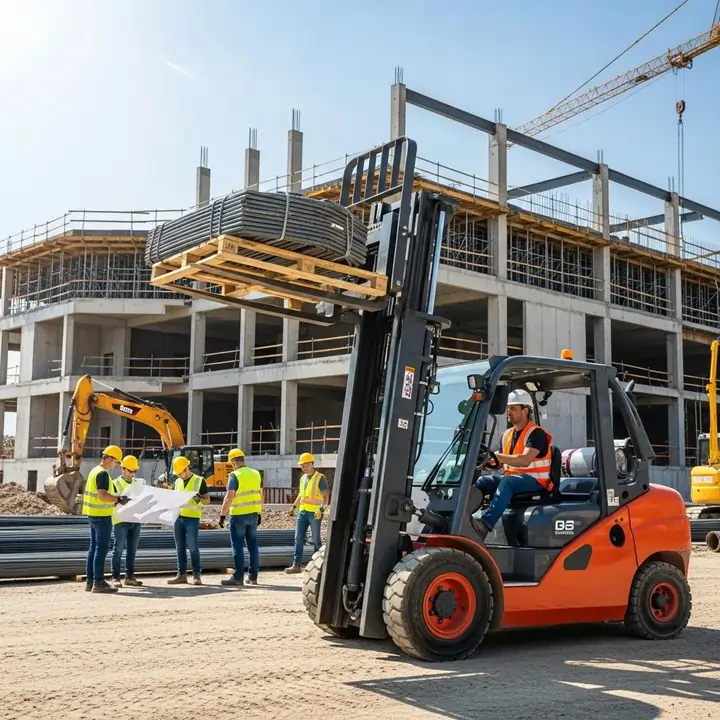
Construction companies and warehouse owners should prioritise expected utilisation, site terrain, indoor vs outdoor use, transport logistics and finance preferences when choosing between hire and purchase. For construction sites with intermittent heavy lifting, hire of rough-terrain or diesel units avoids long-term ownership of niche machines. Warehouses with steady, high-hour operations may favour purchasing electric or LPG fleets to lower per-hour costs and standardise training. Transport constraints such as narrow aisles or truck access influence model selection, while finance preferences determine whether OpEx or CapEx aligns better with company accounting and cash flow.
A practical threshold often used is that more than roughly 1,500 operational hours per year suggests a purchase assessment, though each case benefits from a tailored TCO comparison.
How Can Active Forklift Help You Decide Between Hiring and Buying?
Active Forklift offers comprehensive support across hire, sales and repair services, delivering tailored and flexible solutions that help Australian businesses match equipment decisions to operational needs. Their service mix covers short-term surge hire, long-term contract hire and sales with customisation options, and they provide repair and maintenance support to sustain uptime. Active Forklift’s consultative approach focuses on assessing usage patterns, recommending appropriate equipment types (electric, LPG, diesel, warehouse or rough-terrain) and proposing service levels that balance cost predictability with operational availability. For businesses in Sydney and across Australia seeking guidance, working with a single provider that manages hire, sales and repairs simplifies procurement and lifecycle management.
Active Forklift’s offerings that support flexible forklift use include:
- Short-term surge hire: Rapid delivery of equipment for project peaks with maintenance included.
- Long-term contract hire: Fixed monthly arrangements with agreed service levels and replacement options.
- Purchase with service packages: Sales combined with maintenance agreements to protect uptime.
What Tailored Solutions Does Active Forklift Offer for Flexible Forklift Use?
Active Forklift tailors packages such as short-term surge hire for urgent project needs, contract hire for stable monthly availability and purchase-with-service options that combine ownership with supplier-managed maintenance. Their fleet range covers electric, LPG and diesel models as well as warehouse and rough-terrain equipment, enabling accurate matching of machine type to site conditions. For customers in Sydney and wider Australia, Active Forklift emphasises rapid delivery, competitive and transparent pricing and on-site support to reduce downtime.
These tailored solutions are designed to remove procurement friction and allow businesses to scale capacity without unnecessary capital commitment.
How Does Expert Advice from Active Forklift Support Your Equipment Decisions?
Active Forklift’s consultative process begins with a needs assessment that documents usage estimates, site constraints and maintenance capacity, then produces TCO comparisons and recommended hire or purchase options tailored to the client’s priorities. Their experts can model break-even points, suggest suitable models and attachments, and outline service levels that align with uptime requirements. For businesses that prefer to trial equipment, hire options provide a low-risk way to validate choices before committing to purchase, while purchase-with-service packages offer a smooth transition to ownership with continued support.
Clear next steps typically include requesting a detailed quote, arranging a site assessment or scheduling a demonstration to confirm suitability.
This advisory approach ensures decisions are evidence-based and oriented to operational flexibility, enabling businesses to choose the solution that best supports productivity and financial strategy.